
Authenticity: Statement by art critic Jos de Gruyter: “I, the undersigned, declare that this is an authentic work by P. Ouborg. W. Jos. de Gruyter
Provenance: Galerie Collection d’Art Amsterdam (Cora de Vries) • Private collection Reinier Lucassen
Reinier Lucassen on his collection: “The common thread is really that I have always sought quality, and beyond that it is of great diversity. I am, in fact, an ardent admirer of the work of others whom I consider good.”
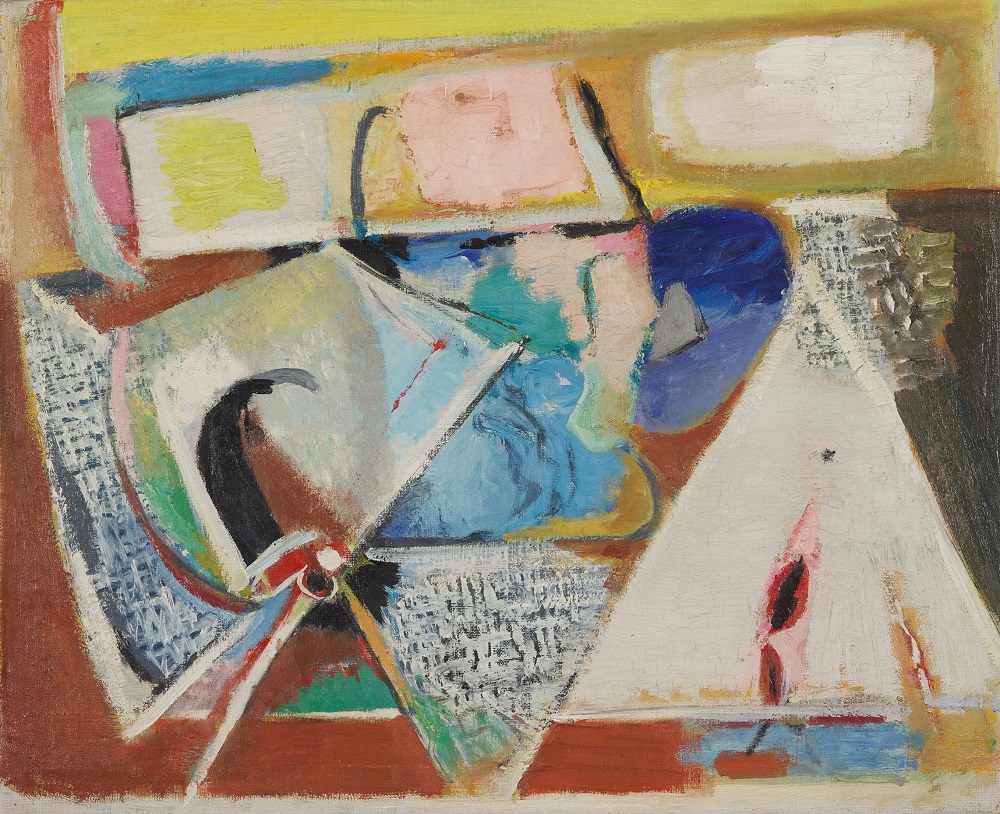
Exhibitions: Oss, Museum Jan Cunen, ‘GrossBild. Overeenkomsten en verschillen in hedendaagse westerse en niet-westerse kunst’, 18 Jan. – 18 April 1993 (illustrated in the catalogue on p. 49) • Amstelveen, Cobra Museum voor Moderne Kunst, ‘Piet Ouborg Solist. Zicht op een eigenzinnig oeuvre’, 12 Dec. 14 March 2010 (illustrated in the catalogue on p. 63)


send me the price
We offer personal viewings and worldwide art shipping.
Piet Ouborg (1893–1956) was one of the most important Dutch avant-garde painters of the last century. The strictly Protestant environment in which he grew up did not result in a lifelong devotion to faith, yet until his death Ouborg remained a serious and deeply inspired man. For him, being an artist was about grasping the essence of things. To that end, he drew from the inexhaustible source of universal, human primal emotions and from an awareness of being part of an immeasurable cosmos.
Ouborg began drawing and painting in his youth and lived for art from an early age. To support himself, he worked for much of his life as a drawing teacher and schoolteacher. He did so in the Netherlands until the middle of the First World War, after which—by his own account—the decisive moment in his life came when, at a young age, he moved to the Dutch East Indies. His homeland felt too confining and too bleak; it bored him, and Ouborg longed for another world. Once there, he encountered a different dimension in his art. He wrote that primitive art had touched him to the deepest core of his soul.
During his first leave in 1923, Ouborg became acquainted with international modern art by Picasso, Bonnard, Mondrian, Chagall, Kandinsky, Klee, and Calder. Of artists whose work he had not seen in person, Ouborg knew reproductions or articles from art magazines. Despite his isolation on the other side of the world, he was extremely well informed about current developments in art. In this respect, he was years ahead of many artists and critics in the Netherlands. Even museums had failed to keep up with modern art for years and needed until after the war to catch up. For his second leave in 1931, Ouborg traveled with his wife to Antwerp, Brussels, and Paris. In the French capital they visited the World Exhibition, in which he himself also participated. In 1938, he returned permanently to the Netherlands.
In his artistic development, Ouborg went through several phases: from abstract Surrealism, via figurative Surrealism, to Abstract Expressionism. Despite his ongoing exploration of different modes of expression, his work maintained a consistent style. The unifying element was an ever-present spiritual intensity. Between 1947 and 1950, Ouborg’s search reached a breakthrough. He developed an Abstract Expressionist painting style with an explosive and colorful visual language. The compositions consisted of a dynamic interplay of elementary forms. In 1947 he wrote: “Oval, square, diamond, rectangle, and trapezoid populate my dreams. Alongside them, less perfect signs.”
Ouborg’s canvases made a strong impression on younger painters such as Anton Rooskens and Theo Wolvecamp, members of the then still-forming Cobra artists’ group. They saw in Ouborg’s work the expression of a radically different kind of painting that the later Cobra artists still had to make their own. Ouborg was at the forefront of the developments that would shape the postwar avant-garde in the Netherlands. After all, through his years in the colony he had personally experienced a primitive culture and had acquired thorough knowledge of Surrealism and the École de Paris. The new rebels of Dutch painting did not have this foundation.
There were affinities between Cobra and Ouborg in their pursuit of a new art, their drive for the expression of life, and their desire to explore the realms of the subconscious. There was shared interest in ethnographic objects, symbolic signs from primitive cultures, and children’s drawings. However, the older and more reserved Ouborg ultimately felt too little like a group-oriented person to join the young movement. Moreover, his visual language possessed a deeper and more personal dimension that differed fundamentally from the wild expression of everyday life advocated by Cobra.
International recognition came to Ouborg on his sixtieth birthday in 1953 with a retrospective exhibition at the Gemeentemuseum The Hague. A year later, this exhibition was taken over by the Stedelijk Museum Amsterdam. These two exhibitions at the end of his life confirmed the importance of Ouborg’s work. Two years after his death, Museum Hofwijck in Voorburg followed with an exhibition in 1958; in 1965 the Van Abbemuseum mounted a show; in 1979 Galerie Nouvelles Images; in 1990 Rijksmuseum Twente; in 1993 the Dordrechts Museum; in 1995 Museum Jan Cunen; and finally the Cobra Museum in 2010.


