Provenance: The Binder family of the Binder bronze foundry in Haarlem, who acquired the sculpture through an exchange agreement with Van der Pant
Literature: R. van der Linden, R. van Put, ‘Theresia van der Pant, Beeldhouwster/Sculptress’, Amsterdam 1989, p. 44 • Floris van der Pant, Joost Bergman, Lien Heyting, ‘Theresia van der Pant’, The Haque 2026, pp. 46,69,101, no. 104, Illustrated
Exhibition: Art dealer M.L. de Boer Amsterdam: Theresia van der Pant, beelden en tekeningen, 1980 • Museum Beelden aan Zee, The Hague: ‘Theresia van der Pant’, Jan 16 – May 3 2026

Was for sale / Sold
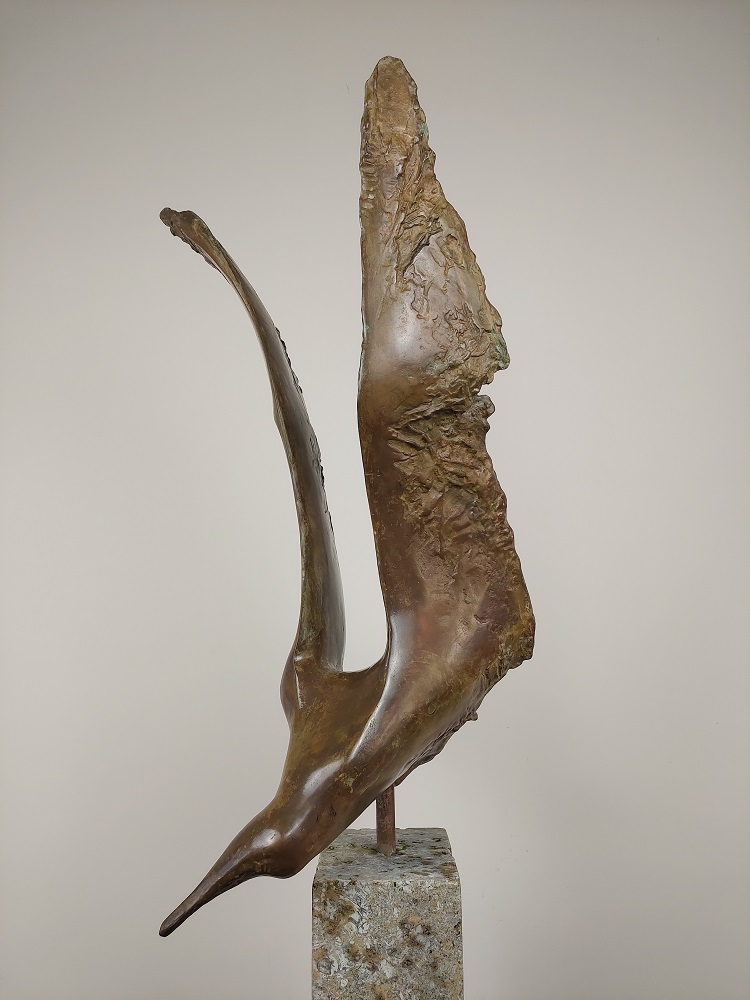
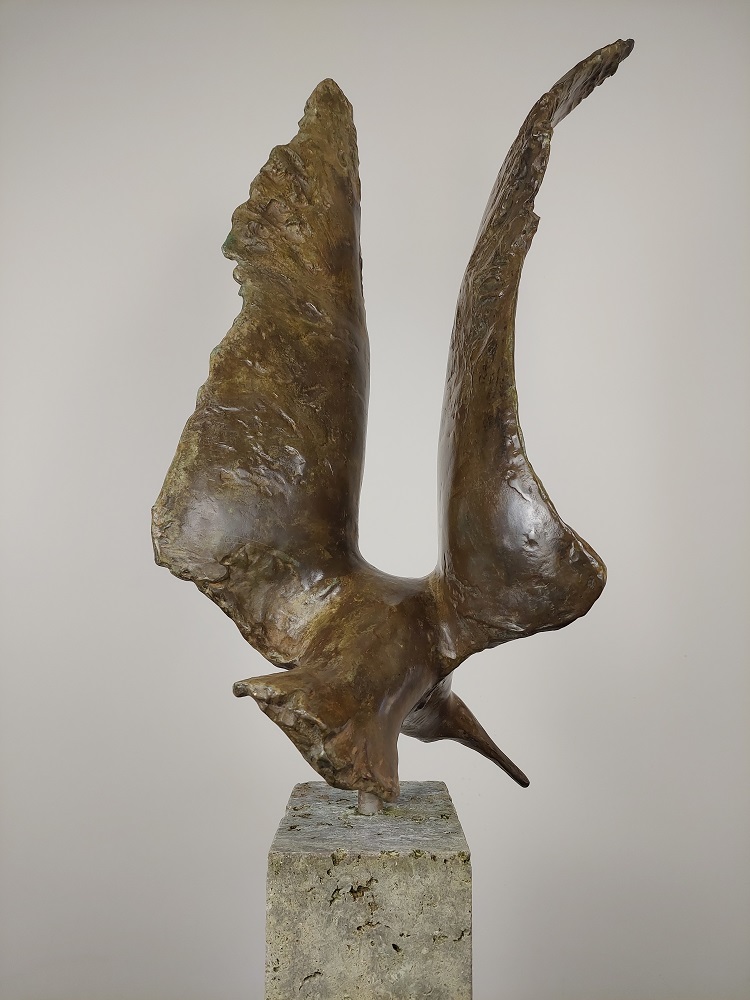
About: From the 1960s onward, two distinct directions can broadly be identified within the animal themes of Theresia van der Pant. These existed alongside one another. One direction focused on depicting animals with a full and closed form, such as a penguin, Baikal seal, and bison. In these works, she subtly abstracted the form away from reality. The same applied to the second direction, which built further on birds she had created earlier. Concrete titles such as Eend (duck) or Zwaan (swan) evolved into Grote vlucht (great flight) or Duikvlucht (diving flight). Van der Pant continued the open plasticity she had achieved, among others, in her giraffes, now expressed through large outstretched wings and extended necks. In both directions, boundaries were pushed. Van der Pant sought to capture the essence.
Like her great example Constantin Brancusi (1876–1957), Van der Pant was searching for the core. Brancusi himself worked during a period in which classical sculpture collided with innovative movements. Before arriving in modern Paris, the sculptor had thoroughly embraced an academic education. Once at the center of European art, Brancusi nonetheless succeeded in renewing his visual language. Natural subjects remained his point of departure, shaped from memory according to his own vision. He also favored direct carving over modeling. Through these innovations, he exerted a major influence on many European sculptors.
Duikvlucht was a continuation of Van der Pant’s Vlucht, which she created in 1974 (2 castings). This bird features only a minimal, horizontally stretched body with beak and tail, and two powerful wings raised upward, conveying a flight in motion. No foot touches the ground. After exhibiting Vlucht several times, Van der Pant decided to revise the plaster model. She was not satisfied with the body and head of the bird. In 1977, she therefore created Duikvlucht, in which the bird turns sideways and curves its tail downward. The sculpture is more dynamic and, through the alertly directed head, more strongly connected to the earth.