Provenance: Art dealer M.L. de Boer, Amsterdam • Collection M. de Smet
Literature: R. van der Linden, R. van Put, ‘Theresia van der Pant, Beeldhouwster/Sculptress.’, Amsterdam 1989, p. 53 • Floris van der Pant, Joost Bergman, Lien Heyting, ‘Theresia van der Pant’, The Haque 2026, pp. 18,92, no. 10, Illustrated

Was for sale / Sold
About: After graduating from the Rijksakademie, Van der Pant apprenticed with the Belgian master Oscar Jespers (1887–1979). Jespers was an internationally oriented sculptor who, over the years, had explored various paths: primitive, abstract, Art Deco, Cubist, Expressionist, and classical monumental. He favored a closed construction of the sculpture, with reverence for the organically grown material from which it was carved. Jespers carved the vast majority of his oeuvre in stone. Van der Pant—who herself was more of a carver than a modeller—learned from Jespers to look more closely and to understand the effect of light on form. A smooth surface captures light very differently from a fractured one. The contrast between the two would remain a constant in Van der Pant’s entire oeuvre.
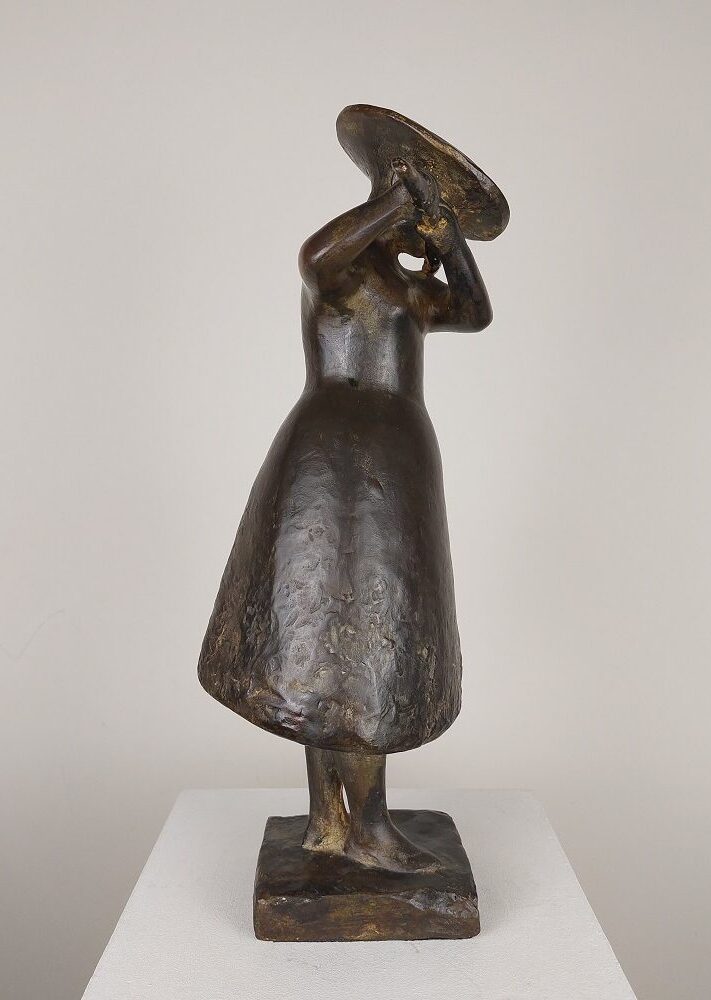
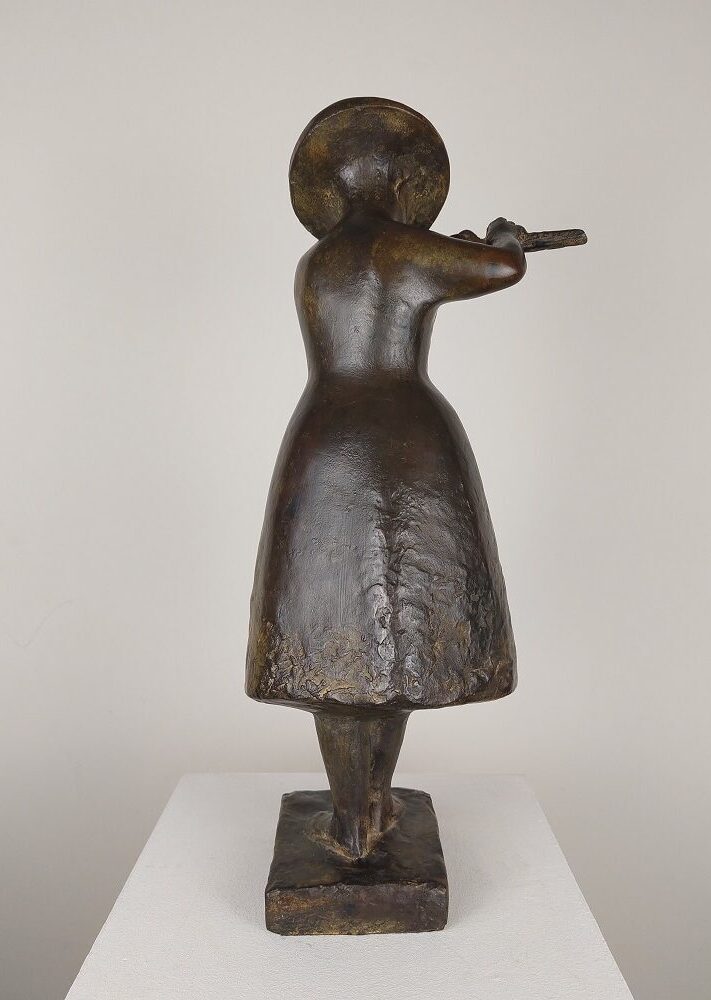
In the period leading up to Van der Pant’s Flemish apprenticeship, Jespers himself had gradually begun working in a more classical manner. This was partly due to government commissions for monumental reliefs. In 1945, Jespers began a series of bronze female figures that were rendered less realistically. The volumes were freely balanced against one another and portrayed woman as a myth of fertility and harmony. Van der Pant was deeply influenced by this series. In the autumn of 1951, once back in Amsterdam, she too created a bronze female figure: Flute Player.
The sculpture is more modest in scale than Jespers’s women. Van der Pant did not attempt to imitate nature; facial expression, drapery, and other non-essential details were deliberately omitted. The full, almost geometric forms of the hat, dress, and body flow into one another through gentle curves, achieving a sense of balance. There is tension within the figure, yet the overall impression is restrained. The sculpture reflects Jespers’s conviction that a work of art must bind the surrounding space to itself by offering resistance. It should not extend into that space, but instead strictly define its own world.